Cutting out snacks entirely will not make you thinner, but eating the wrong ones at the wrong time might slow you down anyway.
Quick Take
- Health experts agree that snacking itself is not the enemy of weight loss, timing and food choice matter more than whether you snack at all.
- Harvard, Mayo Clinic, and the National Institute of Diabetes and Digestive and Kidney Diseases all recommend planned, nutrient-rich snacks over cutting food between meals entirely.
- Research shows evening snacking is more likely to hurt weight loss goals than snacking earlier in the day.
- A federal dietary guidelines review found overall snacking is not strongly linked to obesity, but after-dinner snacking often is.
The Common Advice Everyone Gets Wrong
Most diet plans treat snacking like the villain. Skip it, they say, and the pounds will come off faster. But the Art of Healthy Living recently pushed back on that idea, arguing that the real trick is thinking about what, when, and why you are snacking, not whether you snack at all. That framing lines up with what major health institutions have said for years.
Harvard’s Nutrition Source lays out the same idea in more clinical terms. Their guidance centers on four questions: when, why, what, and how much you eat between meals. Snacks are not treated as optional extras to eliminate. They are treated as a normal part of eating that can either help or hurt your goals, depending on how you handle them.
The National Institute of Diabetes and Digestive and Kidney Diseases takes it a step further, stating plainly that healthy snacks can help combat hunger and prevent overeating later. That is a meaningful distinction. Skipping snacks does not guarantee fewer calories consumed overall. It often just delays hunger until a person overeats at the next meal.
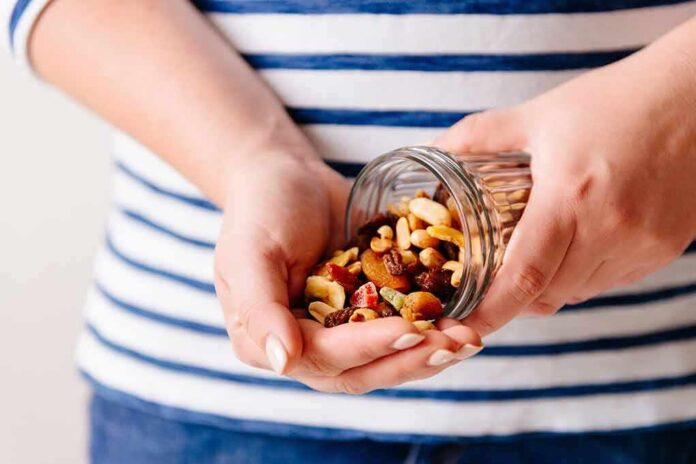
Cleveland Clinic and Mayo Clinic both back this up with practical steps rather than blanket bans. Their advice includes choosing snacks with protein, fiber, and healthy fats to stay full longer, and planning ahead so hunger does not force a bad decision. Pre-cut vegetables, portioned nuts, and fruit kept visible on a counter all show up repeatedly in their guidance.
Why Timing Might Matter More Than People Think
Not all snacking advice lands the same. A study following weight-loss participants found something specific: people who snacked mid-morning lost significantly less weight than those who did not snack at that time, with a documented gap of more than four percentage points in total weight loss. That is not a small difference, and it suggests timing carries real weight beyond just calorie counts.
The federal government’s own dietary guidelines review reached a similar conclusion. Overall snacking showed little connection to body composition or obesity risk. But snacking after dinner told a different story, showing up consistently linked to worse outcomes. That single distinction, before dinner versus after, may matter more than whether someone snacks at all.
A broader systematic review of the science found that discretionary snacking, the extra stuff eaten just because it is available, can raise total calorie intake. Yet the same review noted no consistent link between snacking and rising body weight across cross-sectional studies, while longitudinal data leaned toward showing a real connection over time. Translation: eating more snacks does not automatically wreck a diet, but energy-dense, mindless snacking done regularly tends to catch up with people eventually.
What Actually Works For People Trying To Lose Weight
Mayo Clinic’s practical suggestions focus on preparation. Keep fruit visible. Cut vegetables ahead of time. Pre-portion string cheese or nuts so grabbing a snack does not turn into eating an entire bag. These are not complicated strategies, but they remove the decision fatigue that leads to poor choices when hunger strikes.
WebMD’s reporting on snacking myths makes a similar point directly: cutting out all snacks does not help people lose weight because snacking itself was never the real problem. The problem is choosing chips over protein, or eating straight from the bag without noticing how much disappeared. Simple swaps, like transferring a snack to a bowl instead of eating from the package, have been recommended by registered dietitians as a way to build awareness into the habit.
The pattern across nearly every credible source points the same direction. Snacks are not the obstacle standing between someone and their goal weight. Thoughtless, late-night, energy-dense snacking is. For anyone frustrated by conflicting diet advice, the fix is not more willpower to avoid snacks entirely. It is smarter planning around which snacks, and when.
Weight loss advice often gets oversimplified into rules that sound strict but do not hold up under real research. Snacking bans are one of those rules. The evidence instead points toward balance: nutrient-dense choices, earlier timing, and a little planning ahead of hunger.
Sources:
artofhealthyliving.com, mayoclinichealthsystem.org, connect.mayoclinic.org, health.clevelandclinic.org, webmd.com, gathered.how, loseit.com, today.com