

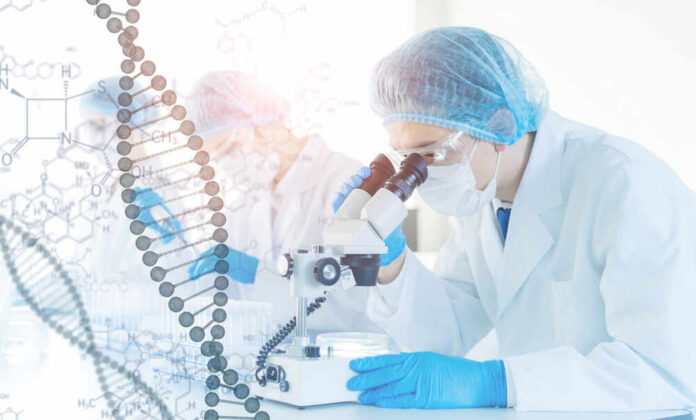
Harvard scientists just turned a silicon chip into a machine that writes DNA — and it stored a 169-byte text message inside the molecules themselves.
Story Snapshot
- A Harvard chip writes 64 different DNA sequences at the same time using tiny electric currents — far more than any previous enzymatic method could manage.
- The chip uses water-based chemistry instead of toxic solvents, making the process cleaner and potentially safer to scale.
- Researchers proved it works by encoding a 169-byte text message directly into synthesized DNA strands.
- Each sequence tops out at 39 nucleotides, which is a real limit for now — but the underlying technology could reshape how biology and data storage are done.
A Chip That Writes the Code of Life
For most of computing history, silicon chips read and processed information. Now a team at Harvard University has built one that writes biological information — DNA — directly on its surface. The research, published in the journal Nature Electronics in July 2026 by professor Donhee Ham and his colleagues, describes a semiconductor chip with 64 individual synthesis sites. Each site uses a small electric current to control local acidity, which triggers a DNA strand to grow one chemical building block at a time.
That process — using electricity to drive chemistry at a precise location — is the core trick. Standard DNA synthesis today relies on phosphoramidite chemistry, a method developed in the 1980s that requires harsh organic solvents and generates chemical waste. The Harvard chip skips all of that. It uses enzymes and water instead, which is both cleaner and more compatible with the kind of miniaturized, chip-based manufacturing the electronics industry already knows how to do.
Why 64 Sequences in Parallel Is a Big Deal
Before this chip, enzymatic DNA synthesis methods could handle roughly a dozen sequences at once. That ceiling was a serious bottleneck. The Harvard chip more than quintuples that number in a single run, with all 64 sequences growing simultaneously under independent electrical control. Think of it like upgrading from a single-lane road to a six-lane highway — the destination is the same, but the throughput changes everything.
The team demonstrated the chip’s real-world usefulness by encoding a 169-byte text message into DNA. That may sound small by digital standards, but it proves the concept. DNA data storage has been a serious research goal for years because DNA is extraordinarily dense — a single gram can theoretically hold hundreds of petabytes of data. A chip that writes DNA electrically, in parallel, and without toxic chemicals is a meaningful step toward making that practical.
Harvard scientists turn a silicon chip into a DNA writing machine | ScienceDaily https://t.co/F9SRe0kfbn
— pdmillett (@pdmillett) July 9, 2026
The Longer Arc of DNA Synthesis History
This breakthrough fits a pattern that has repeated itself in biology for decades. A new synthesis method arrives, researchers call it cleaner and more scalable, and then the hard work of proving fidelity, yield, and cost-per-base begins. Phosphoramidite chemistry went through exactly that gauntlet after Michael Caruthers developed it in 1983. It won because it delivered on scale and accuracy — not just because it was new. Enzymatic platforms from companies like DNA Script have made similar promises in recent years and are still working to close the gap on yield and error rates.
The Harvard chip is a genuine technical achievement. Writing 64 DNA sequences in parallel on a semiconductor using water-based chemistry, then encoding readable data into those strands, is not a minor result. But real breakthroughs earn their status through independent replication, disclosed error rates, and eventually a product someone builds with. The science here is solid enough to take seriously. The next few years will show whether it is solid enough to matter at scale.
Sources:
sciencedaily.com, interestingengineering.com, instagram.com, pmc.ncbi.nlm.nih.gov, linkedin.com