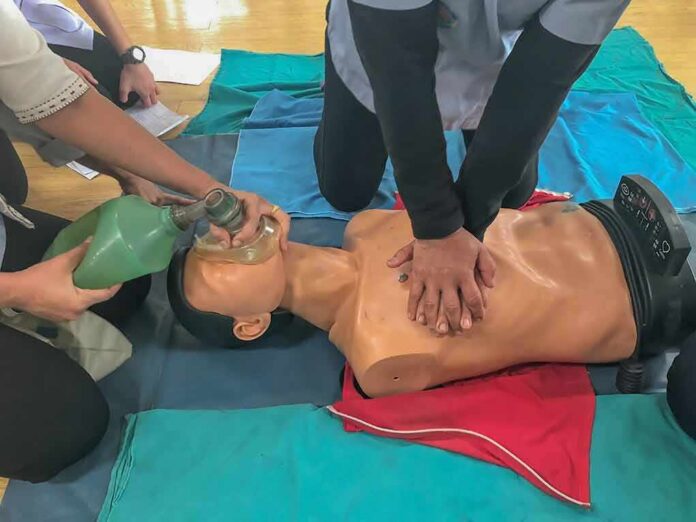
A stranger collapsing in front of you doesn’t have to mean a helpless wait for an ambulance. Hands-Only CPR lets almost anyone keep blood moving to a dying brain using just two steps, no training certificate required.
Quick Take
- Hands-Only CPR skips rescue breaths and focuses on calling 911 plus pushing hard and fast on the chest.
- The American Red Cross teaches it as a simple, learnable skill for people without full CPR training.
- Decades of research show compression-only CPR works about as well as traditional CPR in the first few minutes after a sudden collapse.
- Bystander action matters most because only about one in four cardiac arrest victims outside a hospital currently get help from someone nearby.
What Hands-Only CPR Actually Requires You To Do
The method has two parts, and that’s it. Call 911 or have someone else call, then push hard and fast in the center of the chest until paramedics take over. There’s no mouth-to-mouth step, no need to memorize breathing ratios, and no fear of doing it wrong because you skipped a class years ago.
The Red Cross breaks it into clear steps for an unresponsive adult. Check that the scene is safe, tap the person’s shoulder, and shout to see if they respond. If there’s no answer and no normal breathing, call 911 immediately and start compressions right away.
Hand placement matters more than people expect. Place the heel of one hand in the center of the chest, lay your other hand on top, and interlace your fingers. Push straight down, letting the chest fully rise between pushes, at a pace of 100 to 120 compressions per minute.
Why Doctors Dropped The Breathing Requirement
This shift isn’t new or untested. The American Heart Association first endorsed Hands-Only CPR back in 2008, telling bystanders who witness a sudden collapse to call 911 and push hard and fast in the middle of the chest. The goal was blunt: get more people to actually act instead of freezing up over fear of doing mouth-to-mouth on a stranger.
That fear is a real problem. Research shows only about one in four people who suffer cardiac arrest outside a hospital get help from a bystander before paramedics arrive. Removing the breathing step was a deliberate trade meant to shrink that gap, not a shortcut that sacrifices results.
Multiple observational studies back up the switch. Adults treated by lay rescuers showed similar survival rates whether they received Hands-Only CPR or conventional CPR with rescue breaths. In other words, the simpler method isn’t a watered-down backup plan. It performs close to the full version during those critical opening minutes.
What An AED Adds To The Equation
If someone nearby can grab an automated external defibrillator, known as an AED, do it while compressions continue. The device walks users through its own voice prompts and can deliver a shock that restarts a heart’s normal rhythm when compressions alone can’t. Most public buildings, gyms, and airports now keep one mounted on a wall for exactly this moment.
Dispatchers can also talk you through the process in real time. If cardiac arrest happens and you call 911, put the phone on speaker so the dispatcher can walk you through compressions step by step until help arrives. That guidance removes much of the guesswork for someone who has never taken a class.
Why This Skill Belongs In Every Household
Survival chances for cardiac arrest can double or triple when a bystander starts compressions immediately, rather than waiting for professionals to arrive. Every minute without compressions after a collapse lowers the odds significantly, which is why acting fast matters more than acting perfectly.
Local Red Cross chapters run free 30-minute sessions teaching the technique to anyone willing to show up, no certification needed afterward. For readers who want a refresher or have never learned it, that’s a short time investment that could matter enormously the one day it’s needed.
Sources:
youtube.com, redcross.org, olis.oregonlegislature.gov, redcross.org.hk