

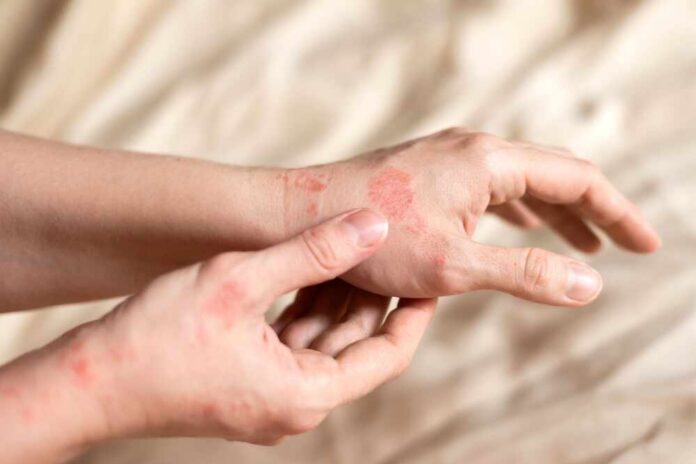
Scientists have finally cracked the code on why your skin erupts in angry red patches the night before your biggest presentation, wedding, or job interview—and it’s not just bad luck or karma.
Story Snapshot
- Fudan University researchers identified the exact neural pathway that transforms deadline stress into eczema flares, publishing findings in Science on March 20, 2026
- Pdyn+ sympathetic neurons act as a biological hotline from brain to skin, recruiting inflammatory eosinophil cells via CCL11-CCR3 signaling within hairy skin tissue
- Mouse studies proved blocking these specific neurons or their chemical messengers completely halted stress-induced flares, opening pathways for targeted drugs
- The discovery validates decades of patient complaints and positions stress management as a legitimate medical intervention alongside topical creams and steroids
The Neural Hotline No One Knew Existed
For generations, dermatologists nodded sympathetically when patients blamed breakouts on exam week or wedding planning, but the mechanism remained stubbornly obscure. Researchers at Fudan University in China dissected data from 51 atopic dermatitis patients and conducted meticulous mouse experiments to expose the culprit: a specialized group of sympathetic neurons marked by prodynorphin expression. These Pdyn+ neurons don’t just relay generic stress signals. They function as precision-guided missiles, targeting skin tissue through beta-2 adrenergic receptors and summoning eosinophils—white blood cells notorious for driving inflammation—via a chemical breadcrumb trail of CCL11 chemokines binding to CCR3 receptors.
Blocking the Biological Panic Button
The elegance of this discovery lies in its reversibility. When researchers genetically deleted Pdyn+ neurons in mice or pharmacologically blocked their downstream signals, stress-induced skin flares vanished entirely. This wasn’t a marginal improvement or statistical wobble; the pathway disruption functioned like flipping a circuit breaker. Optogenetic experiments—using light to activate specific neurons—confirmed the cause-and-effect relationship with surgical clarity. Activating these neurons triggered immediate eosinophil recruitment and inflammation even without psychological stressors, while silencing them protected skin during anxiety-inducing situations. The study, published March 20, 2026, in Science, represents the first time anyone has traced a complete wiring diagram from cortical stress centers to inflamed dermis.
Why Your Body Sabotages You at the Worst Moments
The sympathetic nervous system evolved to mobilize resources during genuine threats—floods of adrenaline to outrun predators, cortisol to suppress non-essential functions. But modern deadlines hijack this ancient machinery without the corresponding physical release. Chronic activation of the hypothalamic-pituitary-adrenal axis floods skin with stress hormones that compromise barrier integrity, making tissue permeable to irritants and allergens. Cortisol simultaneously suppresses lipid production essential for moisture retention while amping up inflammatory cascades. The Pdyn+ pathway adds a parallel route: sympathetic neurons bypass the bloodstream entirely, delivering stress signals via direct neural wiring to hair follicle regions where eosinophils congregate, primed to attack.
From Mice to Medicine
The cautious reality check: these findings emerge primarily from rodent models, though the 51-patient cohort showed correlations between stress episodes and eosinophil spikes consistent with the proposed mechanism. Human nervous systems share fundamental architecture with mice, but translating genetic ablation experiments into FDA-approved therapies requires extensive validation. Researchers are already eyeing drug candidates that interrupt CCL11-CCR3 binding or modulate beta-2 adrenergic activity without triggering the cardiovascular side effects of broad sympathetic blockers. The timeline for clinical trials stretches years, not months, yet the conceptual breakthrough stands firm: stress-induced flares aren’t psychosomatic theater but concrete neurobiology amenable to targeted intervention.
Implications Beyond Eczema
Atopic dermatitis affects over 31 million Americans, but the sympathetic-skin axis likely extends to psoriasis, rosacea, and chronic urticaria—conditions where stress correlates with severity but mechanisms remained murky. If Pdyn+ neurons or analogous pathways drive flares across inflammatory dermatoses, pharmaceutical companies gain a lucrative target for next-generation biologics. The wellness industry smells opportunity too: adaptogens, meditation apps, and vagal nerve stimulators already market stress reduction, and this research provides molecular justification. Economically, effective stress management could reduce reliance on expensive immunosuppressants and steroid courses, though skeptics note the difficulty of “prescribing” meditation to patients juggling demanding careers and caregiving responsibilities.
Stress Management as Legitimate Medicine
The Fudan team didn’t mince words, labeling stress management an “underused strategy” in dermatology. This framing challenges the bifurcation of mind and body that has plagued Western medicine since Descartes. Sleep hygiene, mindfulness practices, and exercise aren’t fluffy self-care add-ons but interventions targeting a documented biological pathway as real as any topical steroid. The research destigmatizes flares by anchoring them in cellular mechanics rather than personal failure or anxiety spirals. Patients reporting “I always break out before presentations” now possess scientific vindication: their Pdyn+ neurons are doing exactly what evolution wired them to do, just in response to PowerPoint slides instead of predators. The practical challenge remains execution—stress reduction demands time and behavioral change in populations already stretched thin.
The discovery transforms skin inflammation from a mysterious stress byproduct into a mappable neural cascade, offering both pharmaceutical and lifestyle intervention points. Whether dermatology clinics integrate meditation protocols or pharmaceutical giants race to patent Pdyn+ inhibitors, the science confirms what patients have known viscerally: the mind-skin connection isn’t folklore but hardwired neurobiology, and breaking that circuit requires understanding its exact architecture.
Sources:
Why Stress Can Cause Skin Flare-Ups And Inflammation According To New Study
Scientists Link Stress to Eczema Flare-Ups
What’s The Connection Between Stress And Eczema Flares
PMC Research Article on Stress and Skin
The Hidden Impact of Stress on Your Skin
Stress May Be Getting to Your Skin