

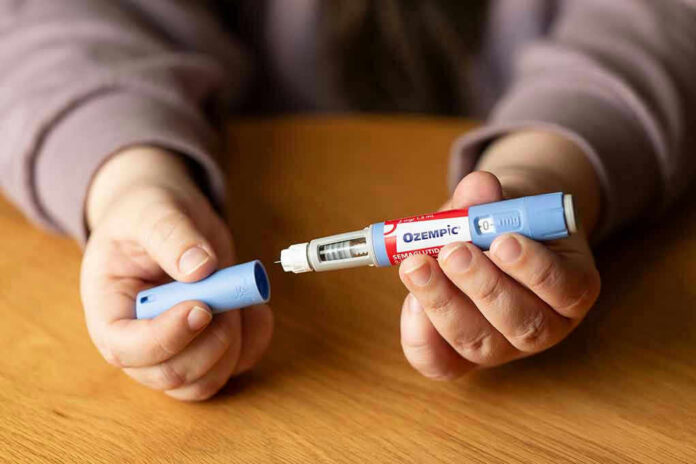
Millions of Americans now inject a weekly shot that melts away pounds, but new research says it likely won’t fix their marriage, job, or mood.
Quick Take
- A 2026 National Bureau of Economic Research (NBER) study found GLP-1 drugs like Ozempic did not meaningfully change mental health, self-rated health, employment, or marriage among diabetic adults.
- The study tracked outcomes over one and two years and found the same weak results both times.
- Celebrities and patients online tell a different story, describing more energy, better sleep, and new confidence.
- Other research shows GLP-1 drugs clearly help blood sugar, weight, and heart health, even if broader life changes stay hard to prove.
What The New Study Actually Found
Researchers behind National Bureau of Economic Research (NBER) Working Paper 35198 set out to answer a bigger question than “does it work.” They wanted to know if GLP-1 drugs change people’s lives beyond the scale. Studying adults with diabetes, they found little evidence the drugs led to measurable shifts in mental health, self-rated health, employment, or marital status.
The University of Chicago’s Harris School, which summarized the paper, noted the researchers checked their work twice. They compared people after roughly one year on the drug and again after two years. The conclusions held steady both times, which strengthens the case that this isn’t a fluke tied to a short observation window.
The Numbers Weren’t Zero, Just Not Proven
The paper isn’t all bad news for GLP-1 optimists. It found a 4.6 percentage-point increase in the probability of working and a 6.7 percentage-point jump in the probability of being married among users. Neither number reached statistical significance, meaning researchers can’t rule out chance. But the direction points toward possible benefit, not harm.
That distinction matters. A truly “null” result would show flat lines across the board. Instead, the data leans positive on work and marriage, just not enough to call it proven. The honest read is “unclear,” not “debunked.” Readers should resist headlines that flatten nuance into a simple yes-or-no verdict on a drug taken by millions.
Diabetes Patients Are Not The Same As Obesity Patients
The study only looked at adults with diabetes, which is a real limitation. Millions of Americans now take these drugs primarily for weight loss, not blood sugar control, and their baseline health, motivations, and life circumstances often look different. Whether the same null result holds for that separate population remains an open question the paper doesn’t answer.
Celebrities And Everyday Users Tell A Louder Story
Oprah Winfrey has written that her medication makes her feel “calmer and stronger.” Amy Schumer says she noticed more energy and better perimenopausal symptoms. Shaquille O’Neal credits his shot with better sleep after years battling obstructive sleep apnea. Everyday patients echo this online, describing new hobbies, more confidence, and money saved on other health costs.
Why Personal Stories And Study Data Can Both Be True
Anecdotes and averages measure different things. A celebrity feeling “calmer” reflects one person’s experience, not a population trend. Meanwhile, a study averaging thousands of diabetic patients can miss real individual gains that don’t show up as a big group-wide shift. Both things can be accurate at once, which is exactly why this topic keeps generating confusing, contradictory headlines.
Global Health Reviewers Reach A Similar Middle Ground
The World Health Organization’s 2025 expert review reached a comparable conclusion on a broader question. It found GLP-1 receptor agonists clearly help with weight loss and waist size, calling that evidence strong. But it described the drugs’ effect on general quality of life as minimal, echoing the American findings on marriage, work, and mood.
Other reviews of trial data found something similar. One large analysis reported semaglutide made little to no meaningful difference on a standard physical functioning score, despite dramatic weight results. The pattern across multiple independent research teams looks consistent: the body changes fast and clearly, while broader life measures move slowly, if at all.
What This Means For Patients Weighing The Decision
None of this means GLP-1 drugs are worthless outside blood sugar and weight. It means patients and doctors should set realistic expectations. Expect real, well-documented physical benefits. Don’t assume a better marriage or job automatically follows. Anyone chasing a full life transformation from a weekly injection may be pinning too much hope on a drug designed to treat the body, not rewrite a biography.
Future research promises to sharpen this picture. Scientists want longer follow-up windows beyond two years, since social and psychological gains might take longer to show up than physical ones. Others want to separate obesity-only patients from diabetes patients, and to track harder-to-measure outcomes like loneliness, sexual health, and daily productivity that current studies simply don’t capture yet.
Sources:
sciencedaily.com, harris.uchicago.edu, era-online.org