

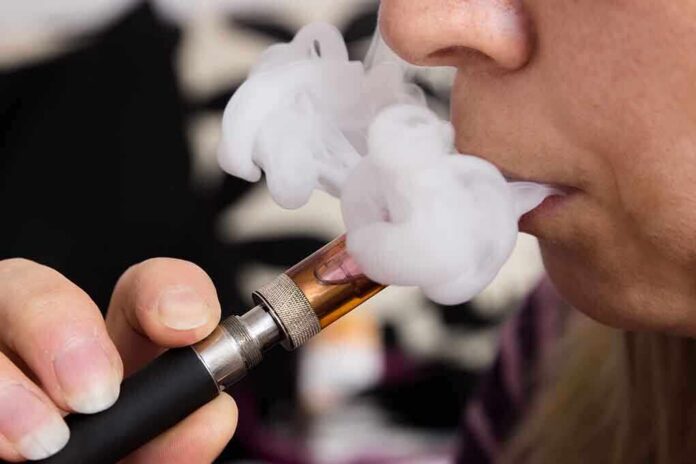
Nearly 30,000 smokers took part in trials testing the best way to quit, and vaping came out on top.
Quick Take
- A major Cochrane review studied 80 randomized trials with 29,861 participants to compare quit-smoking methods.
- Nicotine e-cigarettes beat nicotine patches and gum, helping about 4 more people out of 100 quit smoking.
- Nicotine vapes also beat non-nicotine vapes, with about 2 more quitters per 100 people.
- The findings land as the Food and Drug Administration (FDA) has authorized fruit-flavored vapes, raising fresh debate about youth risk.
A Massive Study Settles A Simple Question
Cochrane, a respected international research group known for reviewing medical evidence, pulled together 80 randomized controlled trials for this update. Nine new trials joined the pile since the last count. Altogether, 29,861 people took part, making this one of the largest side-by-side tests of quit-smoking methods ever assembled. The question was simple: what actually works when a smoker wants to stop for good?
The answer favored nicotine e-cigarettes. Compared with nicotine-replacement therapy, like patches, gum, and lozenges, vapes helped about 4 more people out of every 100 quit smoking. Cochrane rated this high-certainty evidence, its strongest confidence label. That is a meaningful jump for a public health problem that has resisted easy fixes for decades.
Nicotine vapes also outperformed non-nicotine versions, delivering about 2 more quitters per 100 people. That detail matters. It suggests the nicotine itself, not just the habit of puffing on a device, plays a real role in helping smokers break free from cigarettes. A separate Cochrane analysis of 16 trials and 3,828 participants backed this up, finding nicotine e-cigarettes more than twice as likely to produce a quitter compared with no intervention at all.
Why This Review Keeps Changing
Cochrane calls this a living systematic review, meaning it gets updated as fresh trial data arrives. That is unusual for medical research, where studies often sit untouched for years. It means today’s numbers could shift again once more trials finish, but it also means the current conclusion reflects the newest and largest pool of evidence available right now.
The Flavor Fight Complicates The Picture
The timing of this review lands right after the FDA authorized fruit-flavored vapes for the first time, including mango and blueberry products made by Glas, Inc. That decision sits apart from the Cochrane findings. The review studied nicotine e-cigarettes broadly. It did not test whether fruit flavors specifically help smokers quit better than tobacco-flavored vapes.
That distinction matters because flavor is where most of the public argument lives. The American Lung Association has pointed out that no FDA-regulated vape has been formally approved as a stop-smoking medicine, separate from being authorized for sale. The American Dental Association and the American Association for Cancer Research have both pushed back on flavored authorizations, warning that sweet flavors pull in teenagers who never smoked in the first place.
The FDA’s own guidance describes fruit, candy, and dessert flavors as carrying a substantial risk of hooking young people. That risk sits on one side of the scale. Helping adult smokers quit sits on the other. Boston University public health researchers have framed the authorized flavored products as a genuine test of whether regulators can thread that needle without opening the door wider for kids.
The Cochrane review gives smokers trying to quit real, high-certainty evidence that vaping with nicotine works better than older methods. What it does not do is settle the flavor debate, the long-term safety picture, or the youth-access question. Those fights will keep playing out in FDA hearings and state legislatures, even as the underlying science on quitting keeps getting stronger.
Sources:
sciencedaily.com, cochrane.org, lung.org, bu.edu, congress.gov