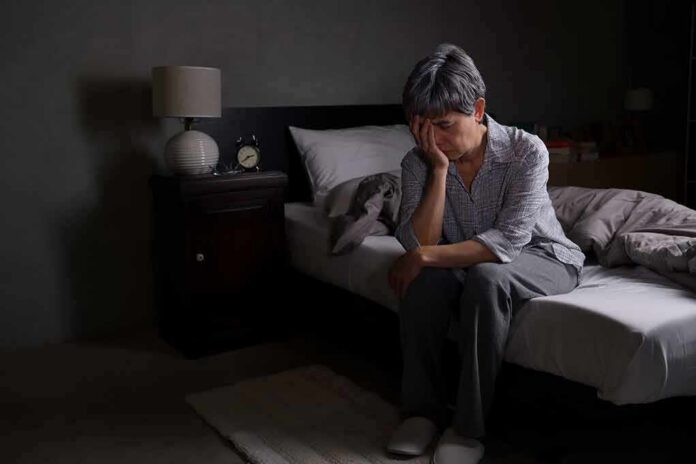
A new clinical trial found that just one night of broken sleep can turn up your body’s pain volume dial, and scientists now know part of the reason why.
Quick Take
- A 95-person randomized trial found forced awakenings cut deep sleep and raised pain-causing inflammation markers the next day.
- Researchers estimate about 35% of the pain-sensitivity increase came from lost deep sleep triggering inflammation.
- Other controlled studies confirm sleep loss raises pain sensitivity, even after just one all-nighter.
- Chronic pain patients report sleep trouble at rates as high as 88%, and the relationship runs both ways.
- The strongest proof so far comes from healthy adults, not chronic pain patients, so more research is needed to confirm treatment benefits.
What The New Trial Actually Found
Researchers ran a carefully controlled, crossover trial on 95 healthy adults. Half the nights, the volunteers slept normally. Other nights, researchers forced awakenings to break up their sleep. The disrupted nights cut deep, slow-wave sleep, the kind your body needs most for repair. Blood tests the next day showed higher levels of two inflammation-driving proteins, interleukin-6 and tumor necrosis factor-alpha, and the volunteers reported more sensitivity to heat pain.
Inflammation Caught In The Act
What makes this trial stand out is the math behind it. Scientists ran a statistical test called mediation analysis to trace cause and effect. They found that nearly 35% of the increased pain sensitivity could be explained by this exact chain: broken sleep reduces deep sleep, which then fires up inflammation, which then dials up pain. That is a real mechanism, measured with actual numbers, not a guess based on correlation.
Two other independent studies back this up. In one, 24 healthy people went a full 24 hours without sleep. Afterward, their bodies struggled to dampen pain signals naturally, and they became more sensitive to pressure and cold. In a second study, just three nights of broken sleep were enough to produce measurable signs of central sensitization, the nervous system’s tendency to amplify pain signals over time, with clear statistical significance.
Why Chronic Pain Patients Should Pay Attention
Insomnia shows up constantly in people who already live with chronic pain. Clinical reviews describe it as highly prevalent and tie it directly to central sensitization and low-level inflammation in the nervous system. Sleep disturbance rates among chronic pain patients run anywhere from 40% to 88%, depending on the population studied, and insomnia itself affects between 24% and 72% of these patients.
The relationship is a two-way street. Pain keeps people awake at night, and then poor sleep makes the pain worse the next day, creating a loop that can be hard to break. One large study of middle-aged and older adults found that unsatisfactory sleep raised the odds of developing new pain by 74%, suggesting sleep problems may predict future pain even more strongly than pain predicts future sleep loss.
What The Research Does Not Yet Prove
None of this means doctors can promise that fixing your sleep will cure your chronic pain. The strongest causal trial tested healthy adults under lab conditions, not people already living with diagnosed chronic pain. A major review on sleep and pain mechanisms states plainly that causality between short sleep, inflammation, and long-term chronic pain has not yet been proven at the population level. The mechanism is real. How much it helps patients in daily life is still being worked out.
Inflammation is also just one piece of a bigger puzzle. Researchers point to central sensitization, stress, anxiety, disrupted circadian rhythms, and psychological factors as other contributors to chronic pain. No single explanation, including inflammation, accounts for the whole picture.
Where Treatment Research Is Headed
Scientists are now pushing to test these findings directly in chronic pain patients, not just healthy volunteers. That means running trials that treat insomnia with structured therapy, then tracking whether pain, function, and inflammation markers like interleukin-6 actually improve over months, not just overnight. Until those studies finish, the honest takeaway is simple and still useful: protecting deep sleep looks like a real, measurable way to keep pain sensitivity from climbing, even if it is not yet a proven cure.
Sources:
mindbodygreen.com, academic.oup.com, pmc.ncbi.nlm.nih.gov, onlinelibrary.wiley.com